Open, Not Vulnerable: Designing a Boundary for Couriers, Pets and Everyday Use
Photo: Ministry of Information Photo Division Photographer, Public domain, via Wikimedia Commons
Security advice often starts with the intruder. That is understandable, but it misses the people who use a boundary most: residents, couriers, visitors, children and the dog. A gate that is difficult to operate, an intercom that nobody can hear and a parcel routine that ends with the gate propped open all undermine the same perimeter they were meant to protect. The best boundary is not the one that looks most forbidding. It is the one the household can use comfortably every day without leaving it compromised.
Map the daily flow before choosing hardware
Start with movements rather than products. How many deliveries arrive each week? Does a courier need to reach a front door, or can parcels stop at the boundary? Is there a dog that must not slip out? Do children leave for school independently? Does a visitor need to park before announcing themselves? Each answer changes the specification.
A practical approach is to design for the ordinary weekday, not the exceptional event. If the gate is heavy, slow or awkward, it will be left open. If the parcel box is in the wrong place, parcels will be left in the porch or thrown over the fence. If the intercom is unreliable, visitors will ring a mobile instead. Security depends on repeatable habits, and habits depend on convenience.
Parcel drops without opening the boundary
The simplest way to keep a gate closed is to make the first delivery point useful. A lockable parcel box can be integrated into a fence line, mounted on a wall or placed on a hard standing outside the secure line. It should be sized for common parcel formats, weatherproof, securely fixed and easy for a courier to identify. Clear signage helps; so does a location that is visible from the road but not so exposed that it becomes a target.
Avoid placing a parcel box where it creates a climbing aid or blocks a gate swing. Think about the courier's route: a box beside a pedestrian gate is convenient, but only if the gate is not the only way to reach it. For larger deliveries, a separate delivery hatch or a designated safe place may be more realistic than expecting every parcel to fit. The aim is to reduce the number of times the gate is opened for strangers, not to eliminate every human interaction.
Intercoms, entry control and clear instructions
An intercom is only useful if it is heard and understood. For a pedestrian gate, a weather-resistant audio or video unit with clear labelling is often enough. For a vehicle gate, a video intercom or app-based entry system can let residents see and speak to visitors before unlocking. Power, data and backup arrangements need to be planned at the outset; retrofitting power to a distant gate is rarely elegant.
Accessibility matters too. Buttons should be reachable, instructions should be brief and the system should fail gracefully in bad weather or a power cut. A visitor who cannot work the intercom will press every button, wait in the road or follow someone else through. A simple, well-positioned unit with a backup release is more secure than a sophisticated system nobody can operate.
Automatic gates: convenience with obligations
Automatic gates can make a boundary feel effortless, which is exactly why they can improve security. A gate that opens from the car and closes behind it is less likely to be left ajar. But automation brings safety and maintenance obligations. Sliding and swing gates have different footprint requirements. Safety edges, sensors and manual release arrangements are not optional extras; they are part of the machine.
The duty cycle matters. A gate used ten times a day is a different proposition from one used by a busy household with deliveries, school runs and visitors. Ask how the operator is rated, how it behaves in a power failure and what servicing it needs. If a gate opens across a public footway or highway, there may be additional permissions or safety considerations. These are practical design questions, not reasons to avoid automation altogether.
Anti-tailgating without building a fortress
Tailgating is the simple trick of following a resident or vehicle through a gate before it closes. The response does not need to be an airlock. It can be a gate that closes promptly, a clear line of sight from the house, good lighting and a routine of checking before entry. Video entry systems and signage can help. For higher-risk sites, a separate pedestrian and vehicle entry, or a controlled delivery point, may be more effective than adding layers of visible hardware.
The goal is to make the boundary predictable. A single clear entry point, a gate that is either closed or deliberately held open, and a parcel routine that keeps strangers outside the secure line will do more than a confusing arrangement of bolts and chains. Security that slows the household down will eventually be bypassed.
Safe zones for pets and children
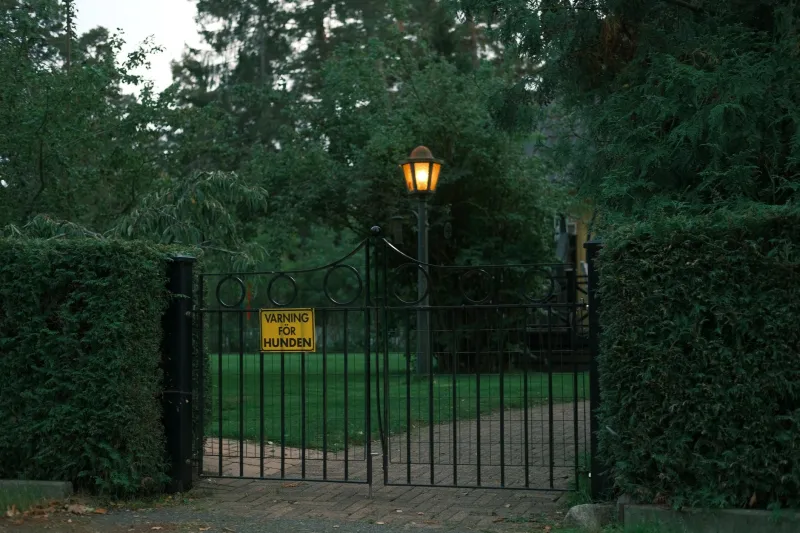
A dog changes the design brief. The boundary must keep the dog in, but it must also allow couriers to deliver without fear and residents to enter without a chase. A double-gate arrangement, sometimes called an airlock, creates a safe zone between the road and the garden. It costs more space, but it can be the difference between a gate that is used and a gate that is avoided.
Check gap sizes at the bottom and sides of gates, the strength of mesh or panels, and the risk of digging under. A separate dog run may be better than trying to make the whole garden escape-proof. For families with young children, the same principles apply: self-closing gates, visible latches and a layout that does not put a child in the road while an adult handles a parcel.
Specification points worth settling early
Before ordering, agree the route a courier will take, where parcels will be left, how visitors announce themselves and what happens in a power cut. Decide whether the gate will be manual or automatic, and if automatic, who will service it. Ask how the parcel box is fixed, how pet-proof gaps will be closed, and whether the gate hardware is covered by a warranty that includes daily use rather than occasional demonstration.
A boundary is infrastructure. It should be designed around the household's ordinary routines, not just an imagined intruder. The most secure gate is often the one that opens easily, closes reliably and has a sensible place for the parcel to wait.