Twelve Places an Intruder Looks First: A Calm Security Audit for Fences and Gates
Most boundary security advice begins with a product: a taller panel, a spike strip, a camera on a pole. In practice, the properties that resist intrusion best are rarely the ones with the most hardware. They are the ones where the boundary has been read carefully, in daylight and again after dark, and where the genuine weak points have been dealt with in order of importance.
The audit below is deliberately unglamorous. It assumes a reasonably typical UK property, whether a suburban garden with a side return or a small commercial yard behind a car park, and it asks twelve questions. None of them requires the place to look fortified, and several cost nothing at all.
Begin with a walk around the line
Before the list itself, one exercise is worth doing. Walk the perimeter from the street at the time of evening when the lights begin to come on. Note where you can see in and, more importantly, where somebody could stand or pass without being seen. Note which gates are habitually left unlocked, and which corners are dark because nobody ever goes there. That single walk will tell you more than any product brochure.
Points 1 to 3: sightlines and the shape of the boundary
1. Is the frontage visible from the street? An intruder values concealment more than height. A low wall with a clear view over it is frequently a better deterrent than a tall close-boarded fence behind which somebody can work undisturbed.
2. Are there gaps at ground level? A 300mm opening beneath a gate, a missing gravel board or a rotten bottom rail all grant access to a hand, then a shoulder, then a person. Examine the base of the boundary as carefully as the top.
3. Has planting removed your own view? Shrubs pressed against a fence look mature and generous, but they also erase the sightline from the house to the boundary. A clear inspection zone of half a metre along the fence line is worth more than any additional height.
Points 4 to 6: the gate, honestly assessed
The gate is almost always the weakest element of a domestic boundary, because it is the part designed to open.
4. Hinges and latches. Latches that can be released by hand through a gap are an open invitation. Specify solid or close-boarded infill so a reach-through is impossible, and hinges with non-removable pins or security bolts so the gate cannot simply be lifted off.
5. Gate posts and ground anchors. A gate is only as strong as the posts carrying it. Check for rot at ground level, confirm the posts are properly set, and consider ground anchors on outward-opening leaves. A heavy gate hung on undersized posts will begin to drop within a season, and a dropped gate is a gate that no longer closes properly.
6. Locking points. A single lock on a lightweight gate can be levered at the far stile. A five-lever mortice lock, a British Standard padlock on a shrouded hasp, or drop bolts top and bottom all increase the time and noise required to defeat the leaf. Keep a record of who holds keys and codes.
Points 7 to 9: light, planting and the senses
7. Lighting, used with restraint. Downward-facing, sensor-operated lighting at the gate and along the dark side return is usually more effective than floodlighting the whole garden. Bright light thrown across a boundary can assist an intruder as much as it discourages one. Aim to light the person, not the fence.
8. Planting as a barrier rather than a screen. A thorny hedge of hawthorn, blackthorn or pyracantha is an unpleasant obstacle and a familiar one in British gardens. Keep it trimmed so it does not become a climbing frame, and remember that boundary height and hedge disputes are governed by their own rules.
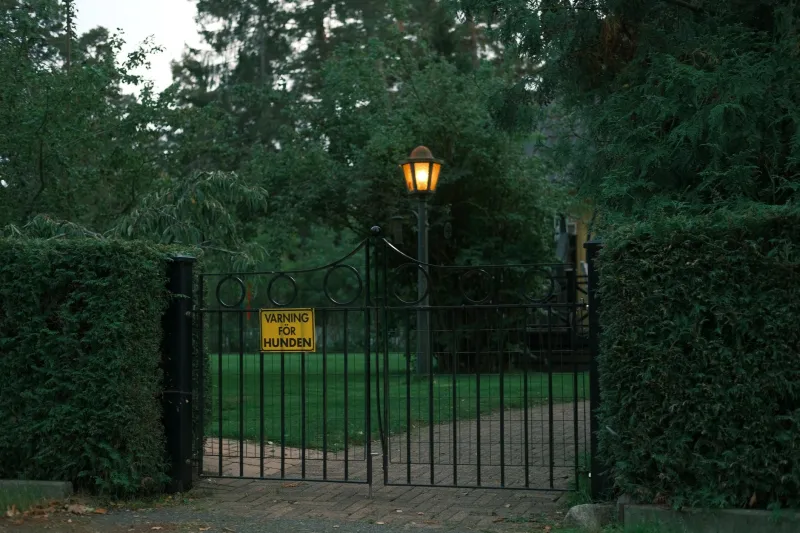
9. Noise and disturbance. Gravel, a creaking gate, a dog and a well-positioned security light are inexpensive and cumulative. None stops a determined intruder; together they make an unattractive proposition.
Points 10 to 12: automation, records and habit
10. Automated gates. Convenience introduces its own risks. Confirm what happens on power failure, where the manual release is kept, whether codes have been changed since installation, and whether the installation includes the force-limiting and detection devices expected of a modern automated gate. A powered gate that is the only layer of defence is a single point of failure with a motor attached.
11. Cameras and alarms in proportion. A camera is evidence after an event, not a barrier before one. Position it to capture faces and vehicle plates at the approach, keep it maintained, and, for commercial premises, consider signage and data protection obligations if it overlooks public ground.
12. Maintenance habits. Security features fail quietly. A quarterly fifteen minutes spent oiling locks, tightening bolts, clearing debris from the gate swing, testing lights, trimming planting and checking post soundness will preserve more protection than adding another device.
Setting priorities sensibly
If budget is limited, spend it in this order: the gate and its posts, the sightlines, the lighting, then planting, and only then electronics. This is the reverse of how security is usually sold, and it reflects where failures actually occur.
There is also a point at which additional measures stop being proportionate. Fortress-style boundaries can sour neighbour relations, complicate a sale and, in some circumstances, require planning permission. A calm, well-maintained boundary that is easy to observe and awkward to cross is almost always the better answer.