Where the Ground Falls Away: Fencing a Garden That Refuses to Be Level

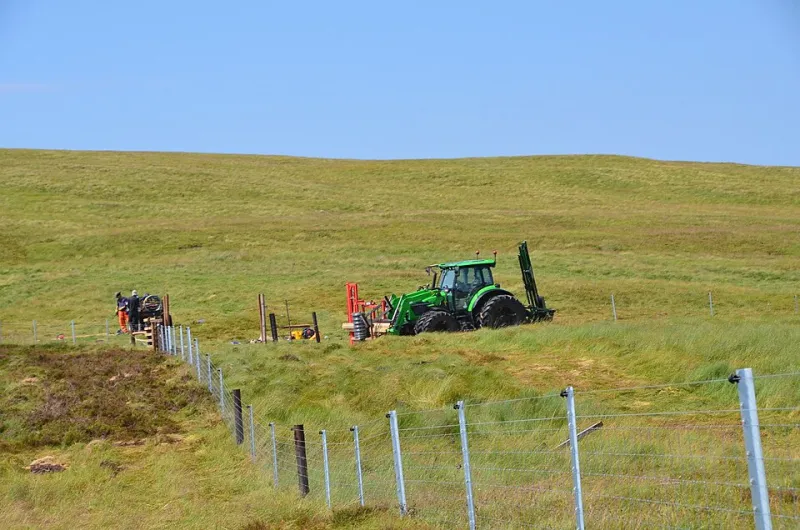
Photo: Basile Morin, CC BY-SA 4.0, via Wikimedia Commons
A fence panel is a rectangle. British gardens, very often, are not. The gap between those two facts is the source of most of the disappointment that follows a cheap installation on sloping ground, and of the reassuring but unhelpful phrase that tends to accompany it: it will be fine.
It is worth understanding what a properly built sloping boundary actually involves, because the difference between a fence that survives ten years and one that leans within two is rarely the panel. It is the setting out, the ground, and the water.
Why a slope changes the job
On level ground a fence is a repetition: the same post depth, the same panel, the same spacing, repeated along a line. On a gradient almost nothing repeats. Post lengths change, the line changes elevation, wind speeds increase with height and exposure, and water that falls on the upper garden arrives at the lower one with purpose. Each of these is manageable, but only if it is anticipated before the first hole is dug.
Following the gradient, or stepping: the two legitimate answers
There are only two sensible ways to run a fence along a slope, and the choice between them is the central decision of the project.
Raking. Here the panels follow the gradient, so the top and bottom rails run parallel to the ground. Close-board fencing can be raked by cutting the boards to a rake, and mesh, palisade and many slatted systems can follow a slope naturally. The result looks continuous and, on gentle falls, is often the tidier option. On steeper ground a raked run can look as though the fence is sliding downhill, and heavily raked panels lose some rigidity.
Stepping. Here each bay is set level, and the fence descends in a series of horizontal steps. Stepping suits moderate to steep gradients and looks deliberate and orderly. It costs more, because every step needs its own post arrangement and more concrete, and it creates triangular gaps beneath the panels, which must be closed with cut gravel boards or infill rather than left open.
As a rough working guide, gentle falls can be raked with the boards trimmed to suit; noticeable gradients on longer runs usually look better stepped; and a change of level within a single bay almost always calls for steps. Mixed approaches along one boundary are rarely successful.
Post depth, concrete and the phrase that should worry you
On sloping ground the temptation is to shorten the hole on the downhill side, because the ground falls away and the depth looks adequate from above. It is not. Posts should be set to a consistent depth measured from the lower ground level, with a proper concrete haunch rather than a loose fill of spoil. Where ground is made up, terraced or previously landscaped, the subsoil may be far less reliable than the surface suggests, and post depths may need to increase accordingly.
A fence post is a lever, and the soil is what resists it. Shorten the lever's anchor and increase the load on it, which is precisely what happens on an exposed slope, and movement is only a matter of time.
Water has to go somewhere
Water is the most commonly overlooked element of sloping boundaries, and the most destructive. A fence run across the bottom of a slope will intercept surface water and hold it against concrete, gravel boards and post bases. Timber that spends the winter in standing water will fail at ground level long before the rest of the panel does.
Practical measures include leaving small drainage gaps beneath gravel boards rather than sealing the run tight, setting posts on a slight collar of concrete that sheds water away from the base, and, where water already concentrates, installing a shallow drainage channel or kerb at the foot of the slope. What should not happen is a new fence acting as a dam, redirecting water onto a neighbour's ground. Land drainage carries its own liabilities, and it is far easier to plan for water than to argue about it afterwards.
When the answer is a retaining structure, not a fence
This is the distinction most often blurred in quotes. A fence marks a boundary and provides privacy and a degree of security. A retaining wall holds soil in place against gravity and water pressure. They do different jobs, and a fence cannot be asked to do the second.
Where a garden has been terraced, or where the boundary sits at the top or foot of a bank of any height, the fence should sit on or behind a properly built retaining structure, with adequate foundations, drainage weep holes and backfill. Structures that retain significant heights of ground may need building regulations approval and structural input, and it is worth confirming the position with local building control before work begins. A fence post bolted to a sleeper wall is not a retaining solution, however neat it looks in the first summer.
Wind on exposed ground
The higher the ground, the harder the wind, and sloping gardens are frequently the more exposed ones. A tall, solid fence on a hillside behaves as a sail, and the load is transferred to the posts and their footings. On exposed sites it is often better to reduce height, to choose a semi-permeable design such as hit and miss boarding, slats or mesh, to tighten post spacing, and to brace the end and corner posts properly. The shelter is not lost by making a fence less solid, and the structure lasts appreciably longer.
Gates on a gradient
A gate must be hung level and must swing level, which means the ground beneath it usually needs adjusting. On a slope this frequently requires a small levelled threshold, a stepped approach or a closing post set at the lower level. Automated gates add a further consideration, since operators and safety devices are designed around particular swing paths and gradients, and the installation should always be specified as a sloped application rather than adapted afterwards.
What a properly built sloping boundary looks like
The visible difference is modest; the invisible one is not. A sound installation begins with levels taken along the whole run, a clear decision on raking or stepping recorded before materials are ordered, post positions marked and depths confirmed against the ground conditions, a plan for where water will go, and an honest conversation about whether any part of the boundary is retaining ground. On completion, the fence should be checked for consistent post alignment, firm footings, closed gaps at ground level and gates that close under their own weight.
If a quotation for a sloping garden arrives without any reference to levels, drainage or stepping, it is worth asking how those three will be handled. The answer will tell you a good deal about the boundary you are likely to end up with.