Guided Light, Not Glare: Planning Fence and Gate Lighting for a UK Boundary
A boundary fence is often the first thing lit and the last thing considered. A floodlight is added above a gate, or a pair of lanterns is fixed to a fence line, and the result is either too little light where it is needed or too much where it is not. Good fence-line lighting is not a question of brightness. It is a question of aim, shielding and control.
Begin with the task, not the fitting
Before choosing a luminaire, list what the light must actually do. The list is usually short: find the gate latch after dark, see the steps between house and garden, identify a visitor at the gate, illuminate a commercial yard entrance, or make a rear access point feel less neglected. Each task suggests a different answer. A route needs low-level, well-shielded light along the path. A gate needs a focused pool of light at the latch and threshold. A yard may need wider coverage, but it still does not need to shine over the boundary.
Lighting the whole garden is rarely necessary and often counterproductive. Bright, uniform light flattens shadows, makes it harder to see beyond the lit area and draws attention to the property from a distance. Local light at the point of use is usually more effective and more considerate.
Keep the fitting on your side of the line
Fix lights to your own posts, walls or dedicated stands, not to a neighbour's fence without written agreement. Check maintenance access before installation: a fitting that needs a ladder balanced on a flower bed will be neglected. Position the fixture so that its beam falls within your boundary and does not cross a neighbour's window, conservatory or seating area. It is worth viewing the proposed position from the neighbour's side before work begins, even if that means asking politely for a moment in their garden. On commercial sites, consider adjacent premises, loading bays, footpaths and the highway.
In conservation areas and around listed buildings, check whether consent is needed for external fittings or for changes to a wall or gate pier. The answer varies by location and by the nature of the building.
Control the beam, not just the output
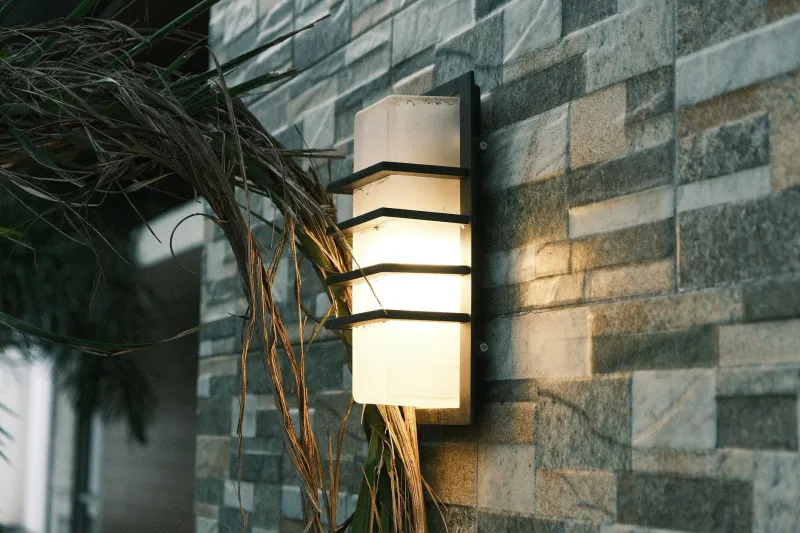
A symmetric floodlight is a blunt instrument. An asymmetric or shielded luminaire sends light downwards and forwards rather than in every direction. Hoods, louvres and baffles reduce spill. Aim the beam at the ground or at the specific surface that needs to be seen, and lock the fitting once set. Keep the light source below horizontal so that it does not throw upward light into the sky or into upstairs rooms.
Colour temperature matters. A warm white of around 2700 K to 3000 K is generally more comfortable in residential settings than a cold blue-white. Use the lowest output that does the job, and choose a narrower beam for a gate and a wider, softer beam for a path. After gales, check that the fitting has not moved.
Treat the gate as a lighting zone
The gate is the most important part of the boundary to light well and the easiest to light badly. The aim is to show the latch, the threshold and the approach, not to create a beacon visible from the end of the lane. A small, shielded downlight above the gate often works better than a wall-mounted floodlight. For automated gates, a low-level light triggered by the gate-open signal can mark the moving edge and the threshold without flooding the driveway. Keep the light on while the gate moves and for a short period afterwards.
Gate hardware and lighting must be planned together. Cables should not run through hinge pinch points or across moving parts. Use a flexible conduit loop at the hinge and a service loop at the gate post. A PIR sensor mounted at the gate should be aimed at the approach, not at the street or at foliage that will move in the wind. Mask the detection zones where possible, and avoid setting sensitivity so high that passing cats or foxes switch on the light all night.
Use controls that match the routine
PIR switching suits occasional use: a visitor at the gate, a trip to the bin, a late arrival. Timers and photocells suit routine lighting: a path that comes on at dusk and goes off at a set time. An astronomical time clock adjusts for sunset through the year and is more useful than a fixed clock for winter evenings. A photocell prevents daytime operation. Set a short on-time of one to three minutes for PIR-controlled lights, and use dimming or part-night operation where the fitting allows.
Separate circuits for gate lighting, path lighting and any security lighting make maintenance and control easier. Label the circuits at the consumer unit. Smart controls can be useful, but they should not be the only way to operate the light. A manual override switch, accessible without a phone or an account, is a practical safeguard.
Route cables as carefully as the fence
Outdoor lighting is electrical work and should be installed by a competent electrician in accordance with BS 7671. Use cable suitable for outdoor use, such as steel wire armoured cable or cable in UV-resistant conduit. Underground runs should be in duct with a draw cord so that a future cable can be pulled through without digging up the garden. Where cable follows a fence, allow for movement and expansion, and keep it clear of posts that may shift. Weatherproof enclosures should be correctly rated, with glands at the bottom and drip loops so that water runs away from the entry point.
At the gate, use flexible conduit and a generous service loop. Keep mains and low-voltage cables separate unless the product is designed otherwise. Protect the circuit with an RCD, and provide a lockable isolator for commercial installations.
Check for light trespass before it becomes a complaint
Light trespass is easier to prevent than to remedy. Before final commissioning, stand at the boundary and at the nearest neighbour's windows. Look for glare, spill and reflected light. Adjust the aim, fit a shield or reduce the output. Avoid dusk-to-dawn floodlighting in residential gardens; it rarely improves security and often annoys neighbours. If a complaint arises, respond calmly and make a change. Local authorities can consider artificial light from premises as a statutory nuisance in some circumstances, but most issues are resolved by a simple re-aim and a shorter timer.
Maintain the scheme through the seasons
Clean lenses and check seals annually. Trim vegetation that has grown into the beam. Test PIRs and timers at the clock changes. Replace failed lamps with the same colour temperature so that the boundary does not become a patchwork. After storms, check that fittings are secure and still aimed correctly. In winter, confirm that gate lighting operates when the gate is used in darkness and that no cable has been strained by movement.
A well-planned boundary light is almost unnoticed from the wrong side. It makes the gate legible, the path safe and the property feel cared for, without turning the neighbourhood into a stage. Plan the task, shield the beam, control the hours and route the cable as carefully as the fence itself.