The Serviceable Screen: Fencing Around a Heat Pump Without Sacrificing Airflow or Access
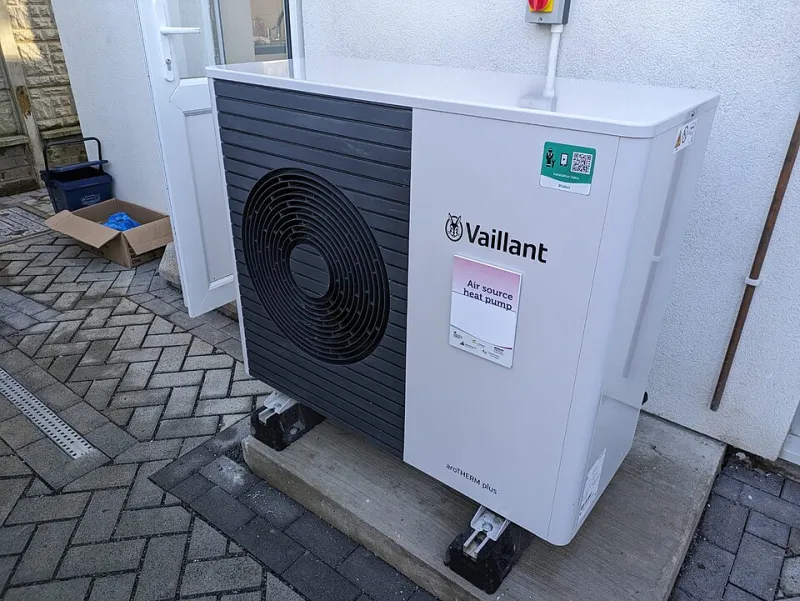
Photo: Southend-on-Sea Borough Council, UK, CC0, via Wikimedia Commons
An outdoor air source heat pump is easy to treat as a plant item that can be tucked away once the garden or yard layout is settled. In practice, it belongs in the boundary plan from the outset. A fence, gate or screen placed too close can restrict airflow, complicate servicing and turn a straightforward installation into a persistent nuisance. The aim is not to hide the unit at all costs, but to give it a defined working zone that remains visible, ventilated and easy to maintain.
Start with the unit, not the fence line
Clearance figures should come from the manufacturer’s installation instructions for the specific model, not from a rule of thumb carried over from a previous job. Different units have different requirements for the front discharge, rear intake and side access. Some tolerate a close rear wall; others need generous space on more than one face. Where the instructions give a minimum, treat it as a minimum for normal operation, not as a target to beat by a few centimetres.
The fence line should then be set around that working envelope. A common mistake is to design a neat rectangular enclosure and assume the heat pump can be squeezed into it. If the resulting gap is tighter than the manufacturer allows, the enclosure may increase recirculation of cold or warm air, reduce efficiency and encourage the unit to work harder. In a small UK side return or a narrow commercial yard, that difference can matter.
Airflow is a path, not a gap
Air must enter the unit and leave it without being drawn straight back in. A screen that stands close to the discharge face can deflect air back towards the unit, particularly in a corner or against a wall. The same applies to solid fencing on two or three sides: even where each individual gap appears adequate, the combined effect can be a pocket of still air and poor performance.
Consider the prevailing wind, the nearest wall and the height of any screen. A louvred or slatted panel may look more open than a solid board fence, but it still needs to be positioned according to the unit’s clearances. Decorative trellis is not a substitute for proper spacing. If the intention is to soften the view rather than create a sealed enclosure, a free-standing screen set forward of the unit is often more sensible than a fence built tight to the casing.
Design for service access
A heat pump is not maintenance-free. Filters, coils, valves, pipework and electrical isolators may need attention, and an engineer should not have to dismantle a fence to reach them. Leave the service panel face clear and provide a route to the isolator. If a gate is fitted, it should open wide enough for tools and reasonable access, not merely for a person to squeeze past.
Removable panels are a practical compromise in constrained spaces. A lift-out bay or a bolted panel that can be taken down without disturbing posts gives future access while keeping the boundary visually complete. Fixings should be accessible and corrosion-resistant, and the panel should be light enough for one person to handle safely. Avoid burying the bottom edge in gravel or soil, where it can seize after wet weather.
Noise and visual screening are different tasks
A fence can obscure a heat pump from view, but it should not be assumed to solve a noise concern. Reducing sound usually depends on mass, sealing and careful positioning, and a thin garden fence may achieve very little. In some cases, an acoustic barrier placed too close can create reflections or trap sound between surfaces. If noise is the main issue, take advice on the unit’s siting and the appropriate barrier before committing to a boundary design.
Visual screening is more forgiving. A slatted screen, a robust trellis with planting or a free-standing panel can break up the outline without enclosing the unit. Keep planting clear of the intake and discharge zones, and allow for growth. A hedge that looks suitably distant at planting can be pressed against the unit within a few seasons.
Condensate needs a route away
In cold weather, an air source heat pump can produce condensate and defrost water. The drainage arrangement should be checked before a fence or gate is positioned across the route. A shallow gravel-filled gully may be acceptable in one location; another may need a proper drain connection. The important point is that water has somewhere to go and does not pool against posts, thresholds or the base of the unit.
Fence post footings should not obstruct the drain or alter the fall of the ground around it. In exposed positions, consider how water will behave during prolonged wet weather and whether a gate threshold will create a dam. A small inspection of levels before digging is more useful than correcting a sodden corner afterwards.
Settle the planning and tenure questions early
In England, permitted development rules for air source heat pumps include siting and noise conditions, and the position may be affected by conservation areas, listed buildings or other local designations. Scotland, Wales and Northern Ireland have their own arrangements. Leasehold properties, rented商业 premises and managed estates may add further consent requirements. Fencing and screening can also require permission in some locations, even where the heat pump itself is acceptable.
Before the boundary line is fixed, check the manufacturer’s clearances, the drainage route, the service access and any consent that applies to the fence or screen. It is far easier to adjust a plan on paper than to move posts after the concrete has set.
A boundary that works with the unit
The most successful arrangements treat the heat pump as part of the working garden or yard rather than an object to be concealed. Give it clear air, a serviceable face and a safe route for water. Use removable or free-standing screening where access is tight, and keep solid fencing from closing in on the discharge. A boundary that looks tidy and still lets the equipment breathe is the one that will remain practical through winter and beyond.